
Author: Kongdy Patch
Date: 05 09,2026
Walk into a pharmacy in Germany, a convenience store in Japan, a sports retailer in Brazil, or a traditional medicine shop in Vietnam — and you'll find capsicum plaster for pain relief on the shelf. Few topical analgesic products span so many markets, consumer demographics, and distribution channels as effectively.
The reason is straightforward: capsicum plaster works by leveraging the well-understood mechanism of capsaicin — the active compound in chili peppers — to create targeted thermal stimulation on skin, improving local circulation and reducing the perception of pain through sustained sensory engagement with nerve receptors. This is not a folk remedy. It is a pharmacologically documented mechanism with decades of clinical reference data.
And now, macro trends in consumer health are accelerating demand in ways that make capsicum plaster market growth one of the more compelling stories in the OTC healthcare segment.
The global topical pain relief market was valued at over USD 12 billion in 2023, with medicated patches and transdermal formats among the fastest-growing sub-segments. Within this category, herbal and capsicum-based pain patches have gained meaningful share as consumers increasingly move away from systemic analgesics (oral NSAIDs, opioids) toward localized, non-invasive options.
Key data points shaping the capsicum plaster demand outlook:
E-commerce acceleration: Online health retail has opened the capsicum plaster category to direct-to-consumer brands in markets previously underserved by physical pharmacy distribution.
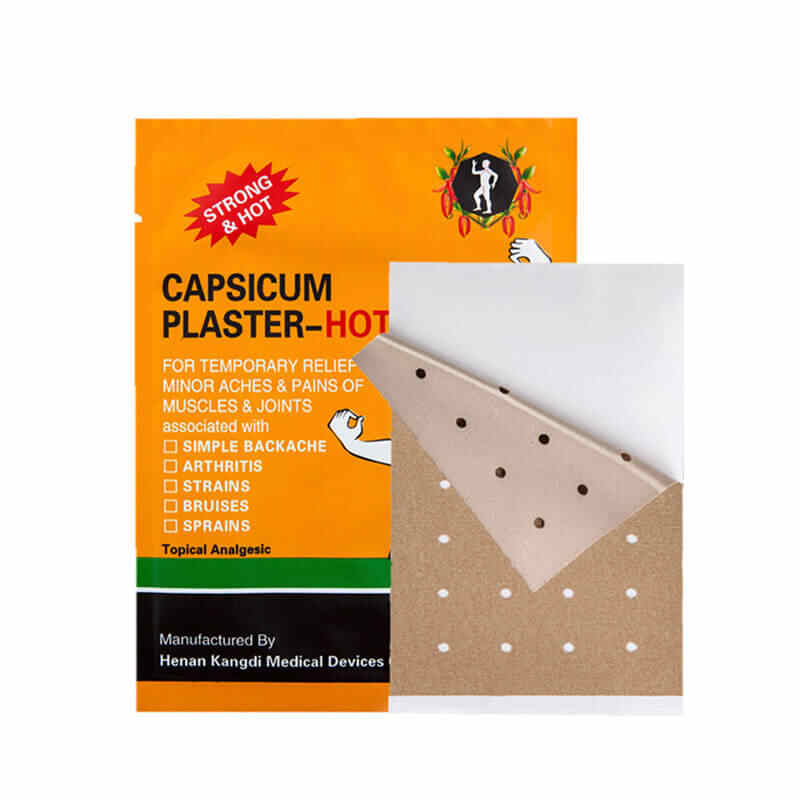
Lower back pain is the leading cause of disability globally, affecting an estimated 619 million people (Lancet, 2023). Capsicum plaster for back pain is the single largest format by sales volume in most markets where the product is established.
The appeal is clear: a single large-format capsicum back pain plaster (typically 10×14 cm or larger) provides 8–12 hours of localized thermal therapy. Users experience relief without oral medication, with a simple, self-administered application. For the chronic back pain sufferer who may manage their condition daily, a product offering this profile at an accessible price point has strong repeat-purchase dynamics.
Brands that have invested in premium positioning for best capsicum plaster for back pain — through better adhesion, longer wear time, or enhanced formulations (e.g., capsicum + menthol + camphor combinations) — consistently command higher shelf prices and stronger consumer loyalty.
The global arthritis therapeutics market is projected to grow at over 7% CAGR through 2030. Capsicum plaster for arthritis represents an accessible, affordable entry point for joint pain management, particularly in markets where prescription anti-inflammatory treatments are out of reach financially or where consumers prefer OTC self-care.
Capsicum knee plaster and capsicum shoulder plaster formats have emerged as distinct SKUs, with anatomical designs that conform better to joint contours. This product differentiation creates upsell opportunities and supports premium pricing without requiring fundamentally different formulations.
In Southeast Asia and the Middle East — two high-growth regions for OTC healthcare — capsicum arthritis plaster is positioned alongside traditional herbal medicine categories, giving it cultural relevance beyond the Western pain relief framing.
The convergence of sports science and consumer health has created a new class of recovery-focused consumer: someone willing to spend more on targeted products that reduce muscle soreness, support joint health, and accelerate return to performance. Capsicum plaster for sports recovery is moving into this premium space.
Unlike traditional pharmacy positioning (elderly consumers, chronic pain), sports recovery capsicum muscle patch products are being marketed to:
This demographic is digitally native, buys online, shares product recommendations, and is willing to pay a premium for products with clean branding, clear ingredient transparency, and sports-relevant packaging. For brands looking to launch a capsicum plaster private label in this space, the market entry opportunity is significant — and the competitive field is less crowded than in the pharmacy back-pain segment.
While Western European markets (Germany, France, UK, Benelux) represent mature, quality-sensitive capsicum plaster demand, the highest volume growth is in:
For distributors and brand owners eyeing these markets, partnering with a capsicum plaster manufacturer who already has export experience, regulatory documentation, and multilingual packaging capability is a critical advantage.
Amazon, Shopify, regional marketplaces (Lazada, Shopee, Noon, MercadoLibre) have fundamentally changed how OTC healthcare products reach consumers. A well-positioned capsicum plaster private label brand can now build significant monthly revenue without traditional pharmacy distribution.
The formula is increasingly well understood: differentiated product (custom formulation, strong packaging, clear benefit messaging), optimized product listings with relevant capsicum plaster keyword targeting, and consistent review generation. Brands doing this well in the pain relief patch space are generating meaningful revenue within 12–18 months of launch.
What makes this accessible is the availability of flexible capsicum plaster OEM manufacturing — where a brand owner can launch with manageable minimum order quantities, test the market, and scale production as demand builds. The barriers to entry have dropped significantly.
Beyond market size data, consumer behavior signals paint an optimistic picture for the category:
Search trend data shows sustained and growing global search volume for terms including:
This is a category where consumers are actively seeking information — meaning content-led discovery and education drives a meaningful portion of the purchase journey. Brands and distributors who invest in educational content around capsicum plaster uses and capsicum plaster how it works capture high-intent traffic at relatively low acquisition cost.
Retail scan data from markets where capsicum plaster is established shows strong repeat purchase rates (typically 50–65% of buyers repurchase within 60 days) — indicative of a product that delivers on its promise and builds habitual use.
One factor that occasionally slows capsicum plaster market entry is navigating regulatory classification. Depending on the market, capsicum plaster may be classified as:
This classification directly affects labeling, permissible claims, distribution channels, and pricing. Working with a manufacturer who has regulatory affairs experience across multiple markets removes a significant barrier to entry.
For brands planning to launch across multiple regions, building a product specification that satisfies the most restrictive applicable standard (typically EU OTC or device requirements) creates a product that can be sold almost anywhere with minor labeling adaptations.
The capsicum plaster category benefits from a rare alignment of factors that support durable, multi-year growth:
For distributors, brand owners, and retail buyers evaluating the category, the case for building or expanding a capsicum plaster product line is well-supported by both data and consumer trend direction.
The question is not whether demand exists — it clearly does. The question is which capsicum plaster supplier you partner with to capture it efficiently, with the formulation quality and supply reliability that supports long-term brand equity.
What is capsicum plaster used for?
Capsicum plaster is primarily used for localized pain relief — including back pain, muscle soreness, arthritis-related joint pain, and sports injuries. The active capsaicin content creates a warming sensation that improves local circulation and modulates pain signaling.
How does capsicum plaster work?
Capsaicin in the plaster binds to TRPV1 receptors in skin nerve endings, initially causing a warming sensation and then, with extended use, reducing the density of these pain-transmitting nerve fibers — a mechanism known as defunctionalization. This is why capsicum plaster for chronic pain can provide sustained relief with regular use.
Is capsicum plaster the same as a heat patch?
Not exactly. Standard heat patches use iron oxidation to generate heat. Capsicum warming plaster uses a pharmacologically active ingredient (capsaicin) that interacts directly with nerve receptors — a mechanistically different and pharmacologically documented approach.
What sizes are available for wholesale capsicum plaster orders?
Common sizes include 7×10 cm (targeted application), 10×14 cm (back/shoulder), and custom sizes for OEM applications. Wholesale buyers can request standard size assortments or specify custom dimensions.
What is the minimum order for capsicum plaster OEM production?
MOQ varies by formulation and packaging complexity. We offer flexible MOQ structures for sampling and market testing, with full-scale production rates for established brands. Contact our team for a specific quote based on your requirements.
Specializing in the integration of scientific research, production and marketing of medical devices


 0086-15517541011
 No.4,2nd Area,SME Poineer Park,Industry Cluster Zone,Huaiyang Country, Zhoukou, Henan, China.
 kongdy202113@gmail.com