
Author: Kongdy Patch
Date: 06 12,2026
Capsicum plaster, also called capsicum patch or chili patch, is a warming pain relief patch that uses capsaicin (the active compound in chili peppers) to provide localized pain relief. With thousands of years of traditional use in Chinese and Korean medicine and modern scientific validation, capsicum plasters have become one of the most popular OTC pain relief products globally, particularly in Asian markets and increasingly in Europe, North America, and Latin America. At Kangdi Medical, we have produced tens of millions of capsicum plasters over 37 years for brands and distributors worldwide. This FAQ guide consolidates the 20 most common buyer questions into a single, citation-ready resource for anyone sourcing capsicum plasters from China.
Jump to the sections most relevant to your needs:
A capsicum plaster is a topical pain relief patch that uses capsaicin (the active compound in chili peppers) as the main active ingredient. When applied to the skin, capsaicin activates the TRPV1 receptors (the heat and pain receptors), producing a warming sensation and depleting Substance P (a neurotransmitter that signals pain). The mechanism provides two-stage relief: immediate warming sensation that distracts from pain, and longer-term reduction in pain signal transmission. Capsicum plasters are widely used for muscle pain, joint pain, arthritis, back pain, and chronic pain conditions.
Capsicum plaster, chili patch, and capsaicin patch are different names for essentially the same product category. Capsicum plaster is the traditional name (used in pharmaceutical and Asian markets), chili patch is the consumer-friendly name (used in some Western markets), and capsaicin patch is the ingredient-focused name (used in scientific and regulatory contexts). The terms are interchangeable, and the choice depends on the target market and brand positioning. At Kangdi Medical, we use "capsicum plaster" as the primary product name, with alternative names available for brand customization.
The typical capsaicin concentration in OTC capsicum plasters is 0.025% to 0.075% (weight/weight), which is effective for pain relief while maintaining skin safety. Low-concentration formulations (0.025%) are suitable for sensitive users and first-time users. Medium-concentration formulations (0.05%) are the most popular and provide effective pain relief for most users. High-concentration formulations (0.075% and above) are used for chronic pain conditions. Prescription-strength capsaicin patches (8% Qutenza) are used for neuropathic pain and require medical supervision. At Kangdi Medical, we provide customization from 0.025% to 0.1% concentration based on market and customer preferences.
The typical ingredients in a capsicum plaster are: capsaicin (the main active, from capsicum extract), menthol (additional cooling and analgesic), camphor (warming and counterirritant), methyl salicylate (warming, counterirritant), eucalyptus oil (cooling and anti-inflammatory), adhesive matrix (the polymer that holds ingredients and adheres to skin), backing fabric (the outer layer that holds the formulation), and release liner (the protective layer removed before use). Some formulations include additional ingredients: ginger extract (warming), turmeric extract (anti-inflammatory), or arnica (anti-inflammatory).
A capsicum plaster typically starts producing a warming sensation within 5-15 minutes of application, with full effect achieved within 30 minutes. The duration of effect is typically 6-12 hours, depending on the formulation and individual user. The warming sensation is most intense in the first 1-2 hours, then gradually decreases as the capsaicin is absorbed. For chronic pain conditions, regular use (daily for 2-4 weeks) produces cumulative pain relief through Substance P depletion.
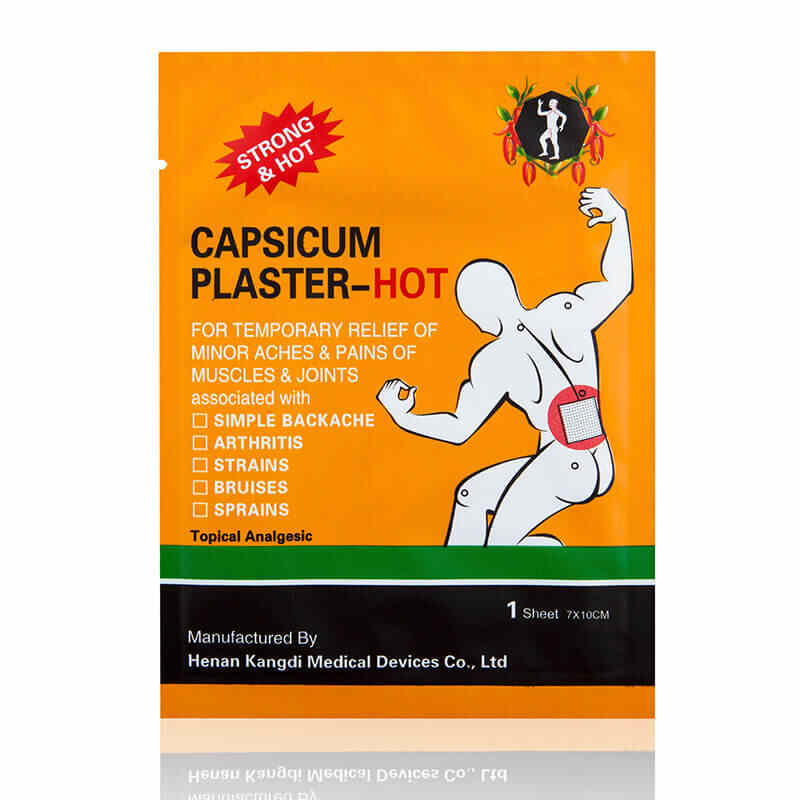
Capsicum plasters are generally safe for most users when used as directed. The most common side effects are: skin warming and burning sensation (expected, indicates the product is working), skin redness (typically resolves within hours of removal), and skin irritation in sensitive users (discontinue use if severe). Safety considerations include: not using on broken or irritated skin, not using on the face or sensitive areas, washing hands after application, keeping away from children, and avoiding hot water or heat sources immediately after use. At Kangdi Medical, our capsicum plasters include detailed safety instructions in multiple languages.
Capsicum plasters are designed for use on muscle and joint areas: back, neck, shoulders, arms, legs, knees, and feet. They should NOT be used on: face (very sensitive skin), scalp (hair interferes with adhesion), genitals or mucous membranes, broken or irritated skin, areas with rashes or infections, and areas with reduced sensation (e.g., diabetic neuropathy). For specific body parts, different patch sizes are available. At Kangdi Medical, we offer standard sizes (7x10cm, 10x14cm, 12x18cm) and custom sizes for specific applications.
Capsicum plasters are generally safe to use alongside other pain medications, including oral pain relievers (acetaminophen, ibuprofen, naproxen) and topical products. However, some combinations should be avoided: do not use with heating pads or external heat sources (risk of skin damage from excessive heat), do not use with other topical pain products on the same area (increased risk of skin irritation), and consult a doctor if using with prescription pain medications. The localized action of capsicum plasters means minimal systemic interaction with oral medications.
Capsicum plasters can be used daily, with one application per day being the most common pattern. For acute pain, use as needed (typically 1-2 applications per day with 8-12 hours between applications). For chronic pain conditions, daily use is recommended for 2-4 weeks for cumulative effect. The skin should be allowed to rest between applications (typically 8-12 hours). Long-term daily use is generally safe but skin should be monitored for signs of irritation. Users with sensitive skin may need to alternate days.
Capsicum plasters should be used with caution during pregnancy and breastfeeding, and only after consulting a healthcare provider. The systemic absorption of capsaicin from topical use is minimal, but the safety data in pregnancy is limited. Some physicians recommend avoiding capsicum plasters during the first trimester as a precaution. During breastfeeding, the plasters should not be applied to the breast area to avoid potential infant exposure. The localized application on other body parts is generally considered lower risk, but medical advice is recommended.
Capsicum plasters are manufactured through a multi-step process: raw material receiving and inspection (especially capsaicin purity and potency testing), formulation and mixing (combining capsaicin, menthol, camphor, methyl salicylate, and adhesive polymers), coating the matrix onto the backing fabric, drying or curing the coated material, laminating with the release liner, slitting into roll form, die-cutting into individual patch shapes, pouching into aluminum foil sachets, secondary packaging, and quality inspection. The production occurs in controlled environments, with in-process testing for capsaicin content and adhesive properties.
The typical shelf life of a capsicum plaster is 2-3 years from the date of manufacture, depending on the formulation and packaging. The shelf life is determined by the stability of the active ingredients (especially capsaicin, which can oxidize over time) and the integrity of the packaging (aluminum foil sachets prevent air and moisture exposure). The shelf life is validated through accelerated aging studies and real-time stability studies. At Kangdi Medical, we provide 2-year shelf life as standard, with 3-year shelf life available for optimized formulations and packaging.
Capsicum plaster manufacturers should meet these quality standards: ISO 13485 (medical device quality management), ISO 22716 (cosmetic GMP), and cGMP (drug GMP, for markets where capsicum plaster is regulated as a drug). The manufacturer should also have: qualified QC laboratory, validated production processes, environmental monitoring, batch traceability, and regulatory documentation capabilities. At Kangdi Medical, we hold ISO 13485, GMP, FDA establishment registration, and CE certification, with comprehensive quality systems for capsicum plaster production.
Capsicum plasters are tested through these quality tests: physical tests (peel adhesion, shear strength, thickness, coating weight, tensile strength), chemical tests (capsaicin content, related substances, content uniformity), microbiological tests (USP<61> and USP<62>), stability tests (accelerated and real-time), and packaging tests (seal integrity, leak testing). The capsaicin content is the most critical quality parameter, typically measured by HPLC (High-Performance Liquid Chromatography). At Kangdi Medical, every batch is tested for capsaicin content with HPLC, and the results are documented in a Certificate of Analysis (COA).
Capsicum plaster packaging options include: individual sachets (most common, 1 plaster per aluminum foil sachet), multi-pack boxes (2, 3, 5, 7, 10, or 20 plasters per box), and bulk packaging (for industrial or institutional use). The sachets are typically aluminum foil laminate to prevent air and moisture exposure, with paper or film outer layers for printing brand information. Custom packaging design is available for brand owners seeking differentiation, with options for: window cutouts, embossed logos, custom colors, and premium finishing (matte, glossy, soft-touch).
The minimum order quantity (MOQ) for OEM capsicum plasters is typically 5,000-10,000 units for standard configurations and 10,000-30,000 units for custom configurations. The MOQ depends on: raw material minimum orders, production efficiency, packaging material minimums, and customization complexity. At Kangdi Medical, our standard MOQ is 5,000 units for repeat orders and 10,000 units for first orders, with lower MOQs available for sample orders and trial runs. For very large custom orders (100,000+ units), we can offer more competitive pricing.
The typical timeline for an OEM capsicum plaster order is: 1-2 weeks for order confirmation and deposit, 2-4 weeks for raw material procurement, 2-4 weeks for production and quality control, 1-2 weeks for packaging and documentation, and 2-4 weeks for international shipping (ocean) or 3-7 days (air). The total is 8-16 weeks for ocean shipping orders, 6-10 weeks for air shipping orders. Faster timelines are possible for sample orders (1-2 weeks) and rush production with appropriate planning.
Capsicum plaster regulatory requirements vary by market. In the US, capsicum plasters with capsaicin concentration above certain thresholds are regulated as OTC drugs by FDA CDER, with compliance with the OTC monograph system or approved NDA. In the EU, capsicum plasters are typically regulated as medicinal products, requiring national authority approval. In most Asian markets (China, Japan, Korea, Southeast Asia), capsicum plasters are regulated as OTC drugs with relatively straightforward registration processes. The manufacturer should provide regulatory documentation for the target market, including COA, stability data, and product labeling review.
The typical OEM price range for capsicum plasters is USD 0.10-0.30 per plaster, depending on size, formulation, customization, and order quantity. Standard configurations in 50,000+ unit orders typically price at USD 0.12-0.20 per plaster. Custom configurations (custom capsaicin concentration, custom sizes, custom packaging) typically price at USD 0.18-0.30 per plaster. Retail prices typically range from USD 0.50-3 per plaster, depending on brand, market, and product positioning. Premium brands (organic, high-concentration, premium packaging) command higher retail prices.
Choosing a capsicum plaster manufacturer in China requires evaluating: regulatory certifications (ISO 13485, FDA registration, CE marking), production capacity and lead times, formulation expertise and customization options, capsaicin sourcing and quality, quality systems and testing capabilities, export experience and documentation, communication responsiveness, references and customer reviews, and commercial terms. We recommend: requesting samples from 3-5 manufacturers, conducting a factory audit, checking references, and starting with a small trial order. The most reliable manufacturers are those with 10+ years of experience, 50+ country reach, and 100+ brand owner partnerships.
Capsicum plasters represent a proven product category with strong consumer demand across multiple regions. The 20 questions covered in this FAQ provide the foundation knowledge for your sourcing and brand building journey. The next step is to apply this knowledge to your specific brand vision, target market, and business model — and partner with a manufacturer that can deliver quality, customization, and reliable supply.
Contact Kangdi Medical to discuss your capsicum plaster brand. Our R&D team provides formulation customization (concentration, ingredients, scent), our production team ensures quality and on-time delivery, and our commercial team supports your market entry with samples, regulatory documentation, and strategic guidance. We are your manufacturing partner from concept to commercial success.
Email: kongdy202113@gmail.com
WhatsApp: +86 15517541011
Website: www.kongdypatch.com
Specializing in the integration of scientific research, production and marketing of medical devices


 0086-15517541011
 No.4,2nd Area,SME Poineer Park,Industry Cluster Zone,Huaiyang Country, Zhoukou, Henan, China.
 kongdy202113@gmail.com